What native commerce actually means inside an LMS, and how to test whether a vendor has it
Most commercial training providers reach a point where they accept that their commercial layer has to change. The harder decision is what to replace it with, and that decision is usually made on the strength of a single phrase that every vendor now uses and few use to mean the same thing.
The phrase is ‘native commerce’. It appears in almost every LMS platform’s marketing, next to integrated, seamless, and connected, and in practice it covers two architectures that behave very differently once a business depends on them. One genuinely removes the operational ceiling described earlier in this series. The other reproduces it under a more reassuring name, and the difference does not become visible until months after the contract is signed, at the month-end when the numbers stop agreeing.
This article gives you a definition of native commerce precise enough to test, a clear picture of what it looks like in a working system, and a short set of questions that separate the genuine version from the lookalike in any vendor conversation. The aim is to let you make this decision on architecture rather than on vocabulary, because architecture is what determines whether the ceiling actually lifts.
Why the phrase cannot be taken at face value
In most platforms marketed as “native commerce”, the commerce layer and the learning platform are two separate systems connected by an API. This is a legitimate engineering approach, and the connection between them is real. The limitation is structural: an API connection is two systems kept in agreement by a process, and any process that keeps two systems in agreement can fall behind, fail quietly, or pass data that each system interprets differently. The reconciliation work that defines the operational ceiling does not disappear in this model. It moves into the integration and out of sight.
This is why the term alone tells a buyer almost nothing. Two vendors can both describe their product as “native commerce” while meaning architectures that diverge completely, one in which commerce and learning share a single record, and one in which they remain two records held in step by synchronisation. In a demonstration the two are difficult to tell apart, because a demonstration shows the system working, not the system reconciling. The divergence appears later, in production, at the point in the month when someone has to explain why three systems report three different figures for the same orders.
A definition you can test
A workable definition is this: native commerce means the commerce layer and the learning platform are one system operating on one shared record, rather than two systems exchanging copies of it. That definition resolves into four requirements, and each maps directly onto one of the operational costs set out in the first article.

The first requirement is a shared user record. The organisation that places an order, the licences it purchases, and the people who consume them exist as one connected record inside the platform, rather than as a commercial record that must be matched to a separate learning record. Where the buyer and the learner occupy the same record, there is no matching exercise to perform, and the licence-tracking spreadsheet that sits at the centre of so many providers’ operations has nothing left to do.

The second requirement is a single point of allocation, with no synchronisation step. If commerce and learning draw on the same data, there is nothing to synchronise and therefore nothing to reconcile. The reconciliation that consumes the back office at month-end does not become more efficient under native commerce; it ceases to exist, because the figures that previously disagreed were only ever separate copies of one figure.

The third requirement is a shared reporting layer. Commercial data, meaning orders, licence pools, allocation, and renewals, can be queried in the same reporting environment as learning data, whether that is the Totara Report Builder or the Moodle reporting tools the team already operates. A report that sets what a client has purchased alongside what its people have completed is produced by one query against one system, rather than assembled from exports drawn from three. The bespoke per-client report that is rebuilt by hand each quarter becomes a standing report that runs on demand.

The fourth requirement follows from the first three, and it is the simplest to verify. The commercial data resides where the learning data resides, and the team can query it directly, without an export or an overnight transfer in between. If a vendor’s commerce data can only be examined after it has been exported elsewhere, the product is two systems, whatever the language used to describe it.
What it looks like in a working deployment
To make this concrete, here is what the definition looks like inside a real deployment of Accipio One Shop, which is built directly into the Moodle Workplace and Totara platform rather than placed in front of it.
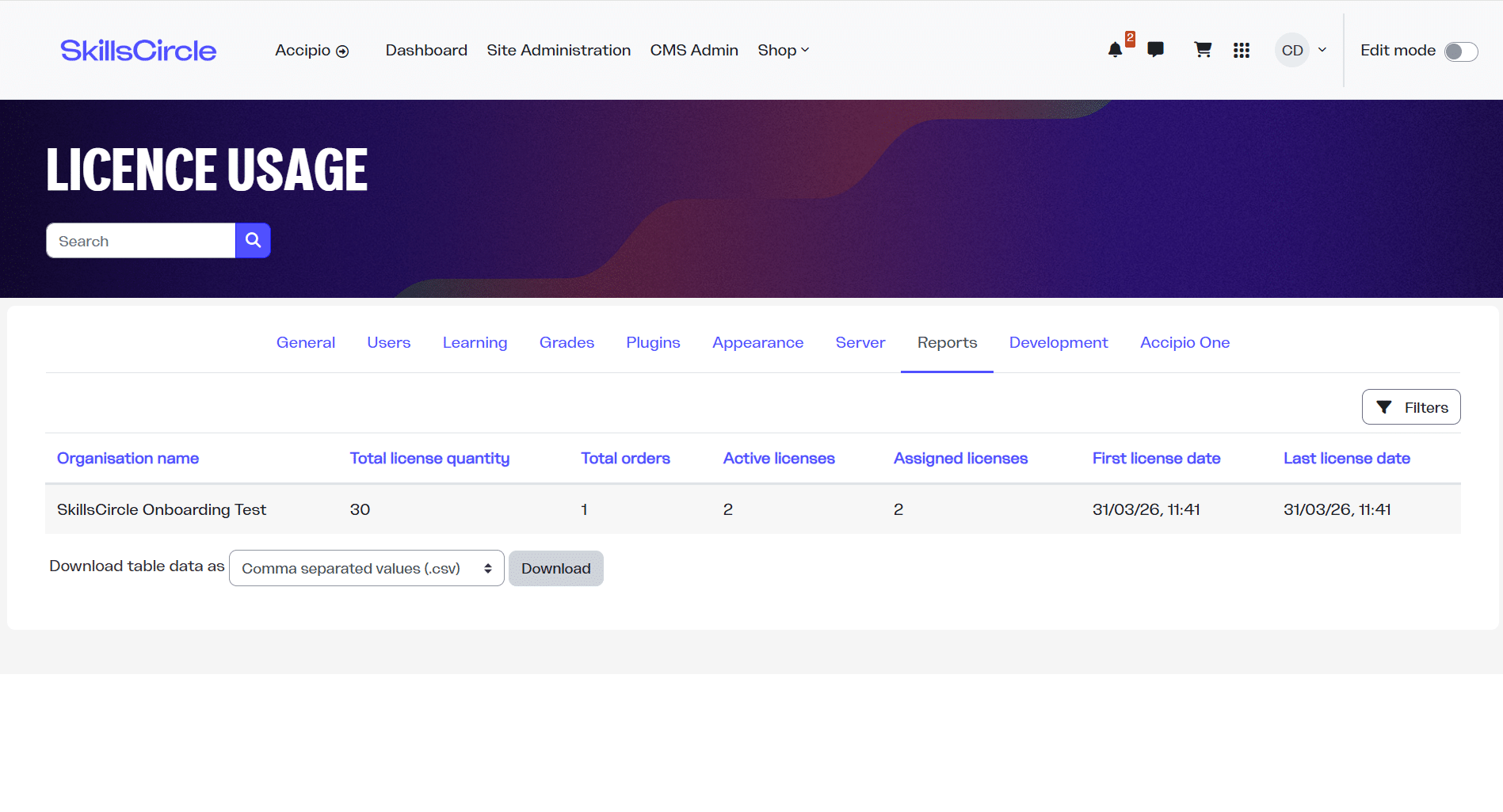
When a corporate order is placed, the licence pool is created and allocated as part of the same action. There is no export into a separate licence-tracking spreadsheet, because the licence pool is held inside the platform alongside the learners who will draw it down. The manual licence tracking from the first article has no job to do here, because the authoritative record of what the client bought and what they have used is the same record the learners are enrolled against.
This is also the point at which the most common, and most reasonable, objection is answered. Most providers hold two convictions at once: that the commercial layer needs to change, and that the business cannot absorb another migration. The second usually prevails, which is why so many providers continue to operate beneath a ceiling they have already recognised.
The distinction that matters is that genuine native commerce, when it is built into the platform a provider already runs, is an extension of that platform rather than a replacement for it. Accipio One Shop adds capability to an existing Moodle or Totara environment. There is no new platform to adopt, no re-importing of users, courses, and completion history, and no second system for the team to learn. The commercial gap can be closed without reopening the migration question, and in practice that is what removes the final obstacle to acting.
The questions that distinguish the two
Owning this definition is what lets you hold every vendor you speak to, us included, to the same standard. The questions below are the practical version. Each one is built so that a loosely constructed “native commerce” gives itself away in the answer, and none of them needs a technical background to ask.
When a corporate order is placed, does licence allocation happen within the same system, or does a synchronisation or export carry it out? A delay, or a reference to an overnight process, indicates two systems.
If you request a report setting what each client has purchased against what it has completed, does it come from a single query, or from joining data held in separate systems?
Is there a reconciliation step at month-end? If so, what exactly is being reconciled against what, and who does it?
Where does the commerce data physically sit, and can my team query it in the same reporting tool we already use for learning data?

When a client tops up their licence pool partway through the year, what happens behind the scenes, and how long does it take to show up everywhere?

If the commerce layer went offline for a day, would learners lose access, or is access independent of it? Independence points to one system. Dependence points to a sync holding two systems together.
What distinguishes the two is whether the answers describe one system performing a single action or two systems being held in step, irrespective of the language the vendor uses. Once a buyer can hear that difference, the whole market can be assessed on the same terms.
What this means for the decision in front of you
The reason this distinction is worth the effort is that it changes the basis on which the decision is made. A platform is usually chosen on the strength of a demonstration and a set of claims, and both favour the vendor whose product looks native without being native, because the gap they share is invisible until the system is in production and carrying real volume. By then the contract is signed, the data has been moved, and the cost of having chosen the lookalike is paid every month, in the same reconciliation, tracking, and reporting the provider set out to escape.
Testing the word moves the decision onto firmer ground. Once a buyer can establish whether commerce and learning share a single record, the choice is made on architecture rather than on presentation, and architecture is the only thing that determines whether the operational ceiling actually lifts or simply returns under a better name.
Talk to us today
Want to see this on real data rather than described on a page? Click the link below to book a demo to see a working deployment!