
25 Nov Before you book a demo: an honest fit-check for Accipio One Shop
Why we are writing this
If you are evaluating ways to sell training through your learning platform, you will have noticed that every vendor says yes. Every platform can take a payment, every demo looks smooth, and every sales call ends with the suggestion that your organisation is an ideal fit.
That makes evaluation slow and expensive. It costs you hours of demos, and it can cost you a year of workarounds if you choose the wrong tool.
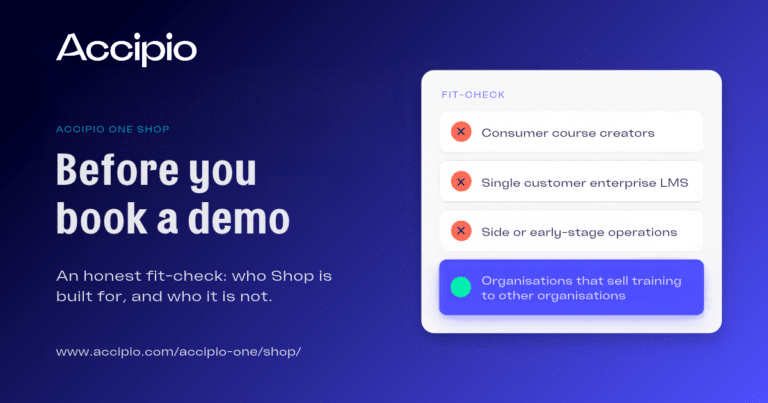
So this post does something most vendor content avoids. It sets out the kinds of organisation Accipio One Shop was not built for, explains why, and suggests where those organisations might look instead. If you recognise yourself in one of the three groups below, we would rather you knew now than after a demo.
The three groups are: creators who only need a course checkout; organisations that train only their own people; and training that does not need a learning platform at all. Each comes with exceptions, which we set out honestly. If you are in none of the groups, the self-check towards the end will help you decide whether a conversation is worth your time.
Who Shop is built for
Accipio One Shop is built for organisations that sell training to other organisations. That usually means commercial training providers, membership bodies, and professional associations whose clients are companies rather than individuals.
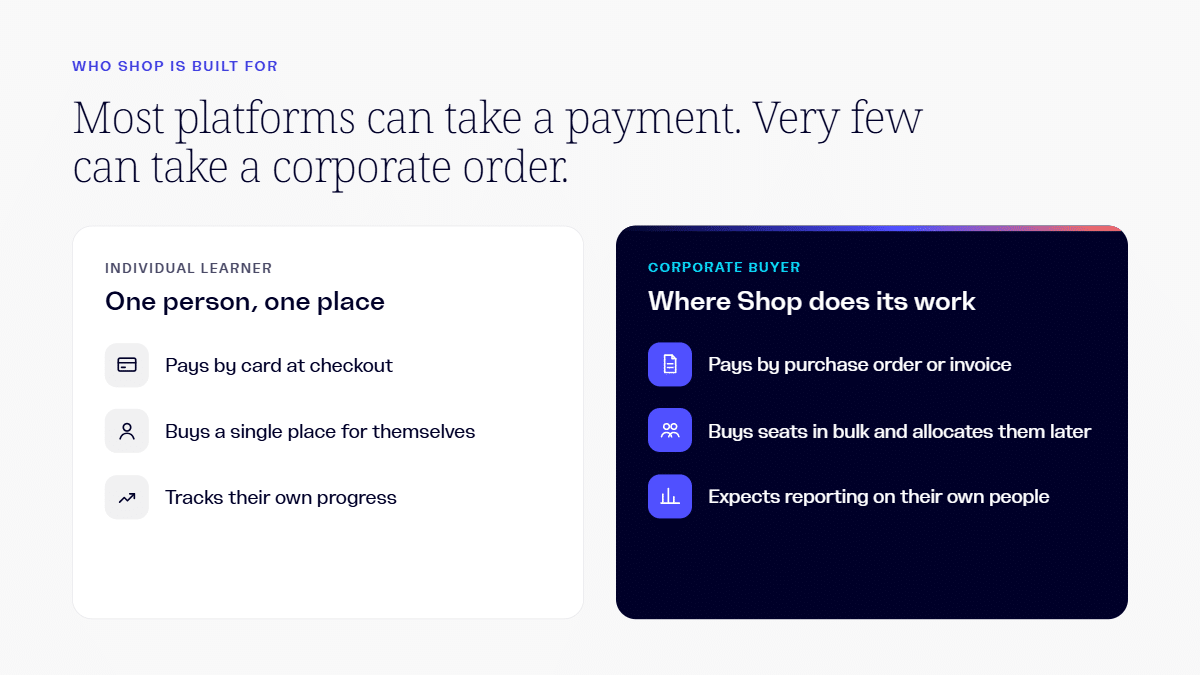
Corporate buyers behave differently from individual learners. They pay by purchase order or invoice, buy seats in bulk and allocate them later, and expect reporting on their own people. Most learning platforms can take a payment. Very few can take a corporate order.
When the platform cannot handle that order, the work moves somewhere else. Purchase orders are chased by email, seat allocations live in a spreadsheet, and month-end is spent reconciling the sales system, the learning platform, and finance. Each client report is rebuilt by hand.
In our experience, the strain becomes hard to ignore once a training business serves more than about 20 corporate clients. Below that, the manual effort is usually manageable, though it grows with every new client. Above it, the business starts to hit what we call the operational ceiling.
Accipio One Shop removes that ceiling by putting the order, the seats, and the learning into one record inside your Moodle, Moodle Workplace, or Totara platform. There is no separate shop to keep in step with the learning platform.
Every Shop customer gets Shop’s own dashboards, summary totals, and exports for orders and seats. On Moodle Workplace and Totara, Shop data is also available as report sources in the platform’s own report builder, so per-client commercial reports can sit alongside learning reports. On Moodle LMS, reporting is more limited and per-client reporting runs through Shop’s dashboards and exports.
Not for: creators who only need a course checkout
If you sell courses to individuals by card and your main need is a simple checkout, Shop is probably more than you need. This group includes coaches, experts, and educators who build an audience and sell directly to it.
Your growth depends on landing pages, email sequences, sales funnels, and community, and hosted creator platforms bundle those with the checkout. Teachable, Kajabi, and Podia are widely used options. They differ in how much marketing, email, and community tooling they include, so compare them against how you sell.
Selling to individuals does not rule Shop out, though. Some consumer-facing organisations need a full learning platform, with structured programmes, assessment, and certification, backed by an integrated way to take payment. Others sell more than courses: event tickets, cohort places, and subscriptions can all be sold through Shop. If either describes you, a conversation is worth having.
The same applies if your customer mix starts shifting towards companies buying for their staff. That shift is often the first sign that a creator business is becoming a training provider.
Not for: a single-customer enterprise LMS
If your learning platform exists to train your own people, you have one customer: your organisation. That is true no matter how large you are or how many departments or regions use the platform.
Internal training may involve budgets and cross-charging between departments, but it rarely involves a purchase order from an outside client, a seat pool bought by another company, or a report sent to someone else’s HR team. Without those, a commerce layer adds administration and cost without solving a problem you have.
What you need is a well-configured, well-supported learning platform. Moodle Workplace and Totara are both strong choices for internal learning, and that is work Accipio does every day. If that is your situation, we are happy to talk about it, but Shop is unlikely to be part of the conversation.
There is an important exception. Some organisations do sell training internally, for example a group that charges its subsidiaries, member organisations, or tenants for places on its programmes. Where each of those buyers pays for its own seats and expects its own reporting, the group is running a commercial training operation, even though every customer shares the same parent. That is a good fit for Shop, particularly on Moodle Workplace or Totara, where each tenant can be kept separate.
The position also changes when you start extending training beyond your own organisation. Training for partners, franchisees, resellers, or your supply chain turns one customer into many. At that point, Shop and Accipio One TMS, which lets each client manage its own seat pool, become relevant.
Not for: training that does not need a learning platform
Size on its own is not the test. A small provider selling online programmes to a handful of organisations may still benefit from Shop, particularly if it expects to grow.
The clearer exclusion is training that does not need a learning platform at all. A consultant running occasional in-person workshops, or a specialist who delivers training alongside a day job, can usually take bookings and raise invoices by hand without difficulty. If you have no LMS and no need for one, an enterprise learning platform with a commerce layer would cost more to set up and run than the problem it solves.
If you simply need somewhere to sell a few online courses, a hosted platform such as those listed above is the easiest route. If you already run a WordPress site, LearnDash with WooCommerce is a common way to sell courses from it.
What if you are not on Moodle or Totara?
Shop runs on Moodle, Moodle Workplace, and Totara. If your training business fits the profile above but runs on another learning platform, or on no platform at all, that does not rule you out.
Accipio migrates organisations onto Moodle, Moodle Workplace or Totara as part of an engagement, with Shop in place from the start. For a business that has already outgrown its current platform, the migration and the commerce problem can be solved together.
We will be honest about the trade-off. A migration is a bigger decision than adding a plugin, and it is only worth making if the operational ceiling is real for you. The discovery conversation is where we work that out together.
The grey zone: not yet, but soon
Many training providers sit between the groups above. They have a growing list of corporate clients, perhaps ten or fifteen, and the manual work is noticeable without yet being painful.
If that sounds like you, the question is one of timing. Some providers adopt Shop before the workarounds take hold, because it is easier to build on the right foundations early. Others wait for clear signs that the ceiling is getting closer. The clearest are a finance team asking for help with month-end, client reports taking longer each quarter, and one or two people becoming the only ones who understand how orders and seats fit together.
When those signs appear, the cost of the workaround is usually growing faster than the business. Our article on the operational ceiling sets out how to measure that cost before you decide.
A five-question self-check
Answer yes or no to each question.
- Do you sell training to organisations, as well as or instead of individuals?
- Do some of your clients pay by purchase order or invoice?
- Do clients buy places in bulk and allocate them to their staff later?
- Do you produce separate progress, or completion reports for each client?
- Do you run a learning platform, or need one, to deliver your training?
Important
If you answered yes to four or five, Accipio One Shop is very likely a fit, and a conversation will be worth your time. With two or three yeses, you are probably in the grey zone, and it is worth watching for the signs above. With none or one, one of the alternatives in this post is likely to serve you better.
What to do next
If the self-check points towards Shop, book a 30-minute conversation with our team. We will start by understanding how your orders, seats, and reporting work today, and we will tell you plainly whether Accipio One Shop solves your problem. Book a conversation.
And if this post has shown you that Accipio One Shop is the wrong fit, we hope it has saved you some time. The right tool for your business is worth more to you than a demo of the wrong one.