

25 Feb Why Bolting On Stripe Doesn’t Make Your LMS a Revenue Engine (And What LMS eCommerce and B2B Training Monetisation Actually Requires)
Here’s what most training providers assume about LMS eCommerce: if you can accept payments, you can monetise training. Add a payment gateway, and revenue follows.
Except it doesn’t work that way. Or at least not in full.
You’ve added payment capability to your LMS. Individual learners can buy courses with a credit card. It works. But here’s what you’re missing: the corporate client who wants 200 licences, the professional body needing a 30-day trial before committing, the enterprise operating on 60-day payment terms. Your payment plugin handles one revenue model. That’s only a fraction of your potential.
Standard LMS payment plugins are only able to capture one revenue stream whilst systematically excluding several others, each potentially worth more than all your individual course sales combined.
The Myth That’s Costing You Revenue
Here’s the narrative most LMS vendors sell: “If you can accept payments, you can monetise training.” They’ll point you towards their LMS eCommerce plugin and API and suggest that adding payment functionality is all you need to start generating revenue.

The reality? Standard payment plugins were designed to do one thing well: let individual learners buy a course, pay immediately, and get instant access. This model works effectively for that specific use case. Think Udemy, Coursera, or hobbyist instructors selling £50 courses to consumers. These tools handle that workflow effectively.
What these plugins cannot do is accommodate the multiple purchasing models that exist in professional training markets. Processing a £15,000 purchase order for 500 licences with 60-day payment terms, bulk licence purchases and management, trial periods, subscription renewals and compliance reporting requires a fundamentally different architecture. The standard payment system simply isn’t built for it.
The stakes here go beyond losing a few sales. When you can only offer one purchasing model, you’re effectively excluding entire customer segments. The corporate buyer who needs 500 licences goes elsewhere. The enterprise that requires 60-day payment terms finds another provider. The professional body wanting to trial your content with 50 users before committing selects a competitor.
Your checkout experience becomes evidence of your limitations rather than your capabilities.
In this post, we’ll examine the specific multi-model monetisation requirements most LMS platforms miss, and we’ll demonstrate what a purpose-built solution actually delivers. By the end, you’ll understand exactly why that payment button isn’t generating the revenue you expected, and what needs to change. And how Accipio can help.
The Single Purchase Limitation Problem
Why Single-Model Payment Systems Leave Money on the Table
Standard LMS eCommerce payment plugins were architected around a single transaction model: one learner, one course, one credit card payment, immediate access. This model serves individual course sales effectively.
However, professional training monetisation requires supporting multiple revenue models simultaneously, not sequentially. Consider what you’re unable to capture with single-purchase systems:
What You’re Missing Without Multi-Model Support:
Corporate Bulk Licencing
- Enterprise clients purchasing 50, 200, or 1,000+ licences in a single transaction
- Volume discount structures incentivising larger commitments
- Administrative capability to allocate and manage licence pools
- Department or team-based licence assignment workflow
Extended Payment Terms
- Purchase order processing and tracking
- Invoice generation with Net 30/60/90 payment terms
- Integration with corporate accounting systems
- Payment status monitoring and automated remind
Trial and Evaluation Programmes
- Time-limited access (7, 14, or 30 days) before purchase commitment
- Content-limited previews (single module access)
- User-limited pilots for organisational evaluation
- Seamless conversion from trial to paid without re-registration
Subscription Revenue Models
- Recurring billing (monthly, annual, multi-year)
- Automated renewal management
- Tiered subscription levels with different feature access
- Upgrade and downsell pathways
Custom Pricing Structures
- Tiered pricing based on user volume
- Course bundles and compliance suites
- White-label multi-tenant portals for resellers
- Organisation-specific commercial arrangements
Each of these models represents a distinct revenue stream. Single-purchase systems force you to choose one. Multi-model platforms allow you to operate all of them simultaneously, capturing revenue from individual learners, small teams, and enterprise clients through the same infrastructure.
The fundamental mismatch between consumer eCommerce and business purchasing creates significant barriers:
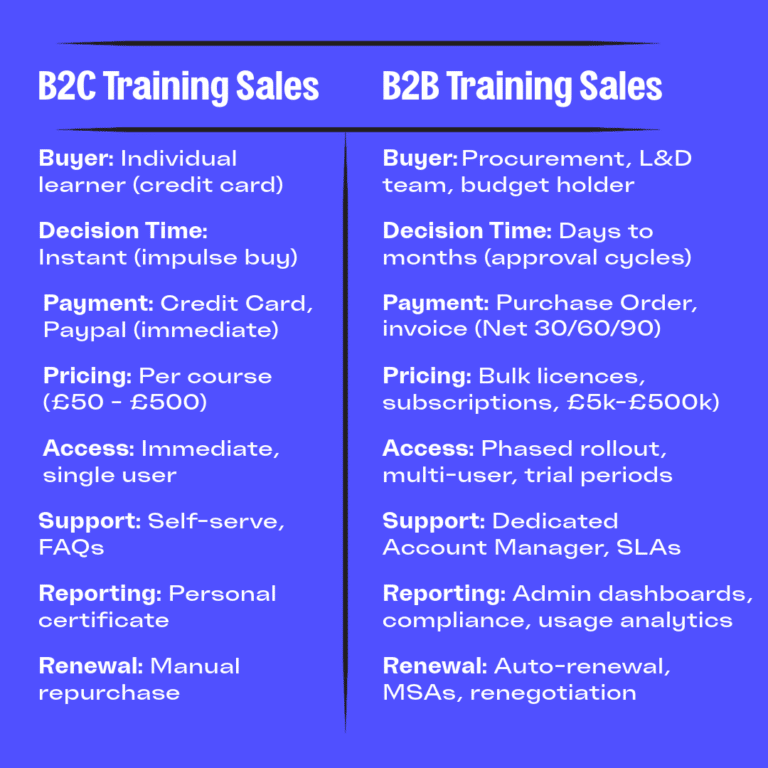
This isn’t merely a difference in scale. It represents a fundamental difference in purchasing architecture.
The Procurement Reality
The limitation becomes particularly acute when engaging with organisational buyers. These buyers don’t operate on consumer purchasing patterns. They operate through established procurement protocols.
Corporate procurement follows established protocols. Buyers raise purchase requisitions, obtain multiple quotes, secure finance approval, verify approved vendor status, negotiate terms, and issue purchase orders. What appears to be a simple transaction in consumer eCommerce becomes a multi-week approval cycle involving multiple stakeholders. If your system cannot accommodate this reality, deals collapse before reaching completion.
The disconnect manifests in several critical ways. Payment terms represent a fundamental requirement, not a convenience. According to a 2023 QuickBooks survey, over 60% of small businesses use a 30-day payment term as their default invoice term, and this figure is even higher for B2B transactions involving professional services and training. This is the standard for B2B professional services, wholesale, and business-to-business transactions.
Systems demanding immediate credit card payment exclude the majority of B2B buyers. Corporates operate on invoice cycles with payment processed 30–, 60–, or sometimes 90–days after invoice clearance through finance. Your commerce infrastructure must accommodate this reality, or buyers will simply engage vendors whose systems do.
Similarly, bulk purchasing operates on entirely different principles. Corporate buyers don’t purchase “1 course × 50”. They purchase “50 licences for Course X at £120/licence with volume discount, 12-month access period, and administrative dashboard for assignment management”. Standard eCommerce “Add to Cart” functionality cannot express these requirements. Bulk licence management, tiered pricing structures, and enterprise-grade administrative tools become essential rather than optional.
The gap between consumer eCommerce and LMS eCommerce for B2B training sales isn’t a minor technical consideration. It’s an architectural mismatch requiring purpose-built solutions designed specifically for enterprise purchasing patterns.
The 7 Non-Negotiables for Multi-Model Training Monetisation
What Your LMS eCommerce Actually Needs
If you’re pursuing B2B training monetisation seriously, these seven capabilities aren’t optional features. They represent the baseline requirements for competing in the enterprise market.
1. Bulk Licence Purchasing & Management
The Problem:
Most LMS eCommerce plugins require buyers to purchase individual seats sequentially. Enterprise buyers need to acquire 50, 200, or 5,000 licences through a single transaction.
What You Actually Need:
- Bulk purchase interface: System supports “Buy X licences for £Y” with automatic volume discount application
- Licence pool management: Administrative dashboard displaying allocated versus available licences
- Assignment workflows: Capability for the purchaser to assign licences to specific users or departments
- Expiry tracking: Automated licence expiry management (typically 12 months or custom terms) with renewal prompts
2. Invoice Payment & Purchase Order Workflows
The Problem:
“Pay Now” checkout requirements terminate enterprise deals before negotiation begins. Corporate buyers operate through purchase order systems and invoice payments with extended terms.
What You Actually Need:
- Purchase Order capture: Checkout workflow includes PO number field for proper accounting integration
- Quote generation: System produces formal quotes (PDF format) including line items and terms & conditions
- Invoice issuance: Automated invoice generation following approval, with configurable payment terms
- Accounting software integration: Direct connection with platforms such as Xero for automated reconciliation
- Payment tracking: Comprehensive monitoring of payment status, automated reminder dispatch, and overdue account tracking
- Credit control: Configurable grace periods with capability to suspend access for significantly overdue payments
3. Trial & Limited Access Options
The Problem:
Enterprises don’t always commit to training purchases without evaluation. More often than not, they require pilots, trials, or limited previews before authorising substantial expenditure.
What You Actually Need:
- Time-limited trials: Typical options include 7-day, 14-day, or 30-day access periods before requiring licence purchase
- Content-limited trials: Restricted access models such as “Module 1 complimentary, full course requires payment”
- User-limited pilots: Structured pilot programmes (e.g., “10 complimentary licences for evaluation, scaling to 500+ upon approval”)
- Frictionless upgrade: Single-click conversion from trial to paid status without re-registration requirements
Research from IdeaProof demonstrates that trial engagement proves critical for conversion. Users who reach their “aha moment” during trials convert at 3 to 5 times the average rate. Shorter trials (7 days) generate urgency and demonstrate higher immediate conversion rates around 40%, whilst longer trials (30 days) increase overall subscription rates through delayed conversion as users develop product dependency.
4. Multi-Tier Pricing & Custom Bundles
The Problem:
Uniform pricing models fail to accommodate the diverse requirements of different buyer segments. Small organisations, for example, require different commercial structures than enterprise clients.
What You Actually Need:
- Tiered pricing: Structured pricing levels (e.g., Bronze: 1–10 users at £X, Silver: 11–50 users at £Y, Gold: 51+ users at £Z)
- Custom bundles: Packaged offerings such as “Compliance Suite” (multiple courses bundled) versus individual course sales
- Volume discounts: Automatic discount application at defined thresholds (50+ licences, 100+ licences, etc.)
- Subscription tiers: Monthly, annual, and multi-year options with discounts incentivising longer commitment periods
5. Admin & Reporting Dashboards for Buyers
The Problem:
Corporate buyers aren’t purchasing courses alone. They’re acquiring compliance proof, performance tracking capabilities, and ROI measurement tools.
What You Actually Need:
- Admin dashboard: Buyer visibility into user completion status, timing, and assessment scores
- Compliance exports: Downloadable completion reports (CSV, PDF formats) for regulatory audit requirements
- Usage analytics: Engagement tracking, at-risk learner identification, and ROI measurement
- User management: Client administrator capability to add/remove users and reassign licences
- SSO integration: Corporate single sign-on support (Azure AD, Okta) for enhanced security and user convenience
6. White-Label & Multi-Tenant Architecture
The Problem:
Organisations selling to multiple corporate clients require branded, isolated experiences for each client rather than shared, generic portals.
What You Actually Need:
- Multi-tenancy: Dedicated branded portal for each client (custom logo, colour scheme, domain)
- Data isolation: Absolute separation ensuring Client A’s learners cannot access Client B’s data (critical for data protection compliance)
- Custom branding: Client brand application across login pages, emails, and certificates
- Sub-portals: Hierarchical portal structure for franchises, dealer networks, or multi-division enterprises
This level of functionality is ideal for training providers serving multiple corporate clients, franchises with 100+ locations, manufacturers with dealer networks, professional services firms selling to diverse client bases.
7. Renewals, Subscriptions & Customer Lifecycle management
The Problem:
One-off sales models fail to generate sustainable revenue. Recurring revenue models with subscription management and automated renewals prove essential for business stability.
What You Actually Need:
- Subscription billing: Automated monthly or annual renewal with transparent opt-out provisions
- Renewal reminders: Scheduled automated communications at 60, 30, and 14 days before expiry
- Grace periods: Post-expiry access continuation (typically 7–14 days) avoiding disruptive hard cut-offs
- Upsell prompts: Contextual upgrade suggestions (“Upgrade to next tier” or “Add additional licences”) during renewal process
- Churn prevention: At-risk customer identification through engagement metrics and payment issue tracking
For subscription businesses, customer lifetime value represents a critical metric. Improving customer retention generates greater value than customer acquisition, with businesses typically investing five to seven times more acquiring new customers than retaining existing ones. The optimal ratio of Customer Lifetime Value (CLV) to Customer Acquisition Cost (CAC) is 3:1 or higher, meaning each customer should generate at least three times their acquisition cost.
These seven requirements aren’t nice-to-have features for future development. They’re table stakes for serious B2B training monetisation and having a proper functioning LMS eCommerce site. Without them, you’re not competing for enterprise training contracts. You’re dependent on occasional small purchases that will never scale into meaningful revenue.
Why Most LMS eCommerce Solutions Fall Short
1. The Root Problem: Single-Model Tools in a Multi-Model Market
Most LMS eCommerce plugins weren’t designed to support multiple purchasing models simultaneously. They were built for one specific use case: individual course creators selling to individual learners. One buyer, one credit card, one course, immediate access, simple pricing.
These plugins handle that single model effectively. However, professional training monetisation requires supporting multiple revenue models concurrently, not sequentially.
2. The “Frankenstein Integration” Problem
Some organisations attempt to piece together separate tools to create enterprise-capable systems: LMS + external eCommerce platform (such as Shopify or WooCommerce) + invoicing software + licence management system + reporting tools.
This approach creates several critical problems:
Fragile integrations: Each connection between systems represents a potential point of failure. Software updates can break integrations, requiring developer intervention to restore functionality. This increases both cost and downtime.
Manual administrative work: Staff must manually synchronise users between systems, track licence allocations, pursue invoice payments, and reconcile data across platforms.
Poor user experience: Buyers encounter multiple logins, disjointed purchasing journeys, and inconsistent interfaces. Each friction point increases abandonment risk.
High maintenance costs: Ongoing developer time becomes necessary monthly to maintain integrations, resolve bugs, and add functionality. These costs compound over time.
3. The Open-Source Gap
Moodle and Totara are excellent learning platforms: genuinely powerful, flexible, and trusted by organisations worldwide. However, their native eCommerce capabilities remain limited. Building the seven B2B features we’ve described requires significant custom development.
By the time you’ve built these features, maintained them through platform updates, and added new functionality as requirements evolve, you’ve invested far more than a purpose-built solution would cost, whilst simultaneously creating additional legacy code requiring ongoing maintenance.
This is where purpose-built B2B training commerce platforms fundamentally change the equation.
Introducing Accipio One’s Shop: Built for Multi-Model Training Monetisation
AccipioOne’s Shop isn’t a bolt-on payment plugin. It’s a purpose-built training LMS eCommerce platform, natively integrated with Moodle and Totara, designed by people who understand how enterprises actually buy training.
Here’s what makes it different:
1. Native Bulk Licensing
Buyers can purchase 10, 100, or 1,000 licences through a single transaction. Volume discounts apply automatically based on configurable rules. Admins manage licence pools, assign licences to users, and track usage, all from one unified dashboard.
2. PO & Invoice Workflows Built In
AccipioOne’s Shop supports complete purchase order workflows as standard functionality (need to verify how this works in Shop):
- Buyer enters PO number at checkout
- System generates formal quote (PDF) for approval
- Invoice issued with configurable payment terms
- Integrates with ??(Xero and QuickBooks) for automated accounting
- Payment tracking with automated reminders and configurable grace periods
No More Manual Invoicing: The system handles end-to-end invoice management, allowing you to focus on delivering training rather than chasing payments.
3. Flexible Trial & Preview Access
Offer time-limited trials (typical options include 7-day, 14-day, or 30-day periods), content previews (Module 1 complimentary), or pilot licences (10 complimentary for evaluation). Conversion to paid status is seamless: one click, no re-registration required.
4. Multi-Tier Pricing & Custom Bundles
Create Bronze/Silver/Gold pricing tiers, bundle courses into compliance suites, and apply volume discounts automatically. Pricing is completely flexible: per user, per course, subscription, or one-off purchases. You control the commercial model.
Example: “Compliance Suite: 5 courses, 50 licences, £10K (versus £15K if purchased separately)”. AccipioOne’s Shop handles the pricing logic, applies discounts, and tracks entitlements automatically.
5. Enterprise-Grade Admin Dashboards
Your buyers receive enterprise-quality administrative capabilities:
- Track which users completed training in real time
- Export compliance reports (CSV, PDF) for regulatory audits
- Manage users (add/remove, reassign licences)
- SSO integration (Azure AD, Okta) for seamless corporate login
- Usage analytics to prove ROI and identify engagement patterns
6. Multi-Tenant & White-Label Functionality
Selling training to multiple clients? Each receives their own branded portal with custom logo, colours, and domain, fully isolated from other tenants. You manage all tenants from one central admin console, eliminating the need to run multiple LMS instances.
7. Recurring Revenue Built In
Subscription billing, auto-renewals, renewal reminders, grace periods, and upsell prompts: everything automated. Transform one-off sales into predictable recurring revenue.
8. Individual Course Sales Too
Accipio One’s Shop maintains full support for individual learner purchases with immediate credit card payment. The difference is that individual sales operate alongside bulk licensing, subscriptions, and enterprise purchasing, not instead of them.
The Bottom Line:
AccipioOne’s Shop provides everything you need to monetise your eLearning content across all customer segments: available immediately, natively integrated with Moodle and Totara, and maintained by a team that understands B2B training commerce.
It’s not a workaround.
It’s a purpose-built solution for organisations serious about capturing training revenue.
Who Should Use Accipio One’s Shop?
Ideal Use Cases & Customer Profiles
You’re a Perfect Fit If You’re:
Training providers selling courses to multiple corporate clients (compliance, leadership, technical training)
Professional services firms (accountants, lawyers, consultants) monetising internal expertise as CPD courses
Higher education commercial CPD arms selling executive education, micro-credentials, or alumni training programmes
Technology and SaaS companies offering partner certification programmes or customer onboarding training for revenue
Manufacturers with dealer or distributor networks requiring branded training portals and bulk licensing
Franchises providing training to franchisees where each location receives a white-labelled portal whilst you manage centrally
Membership organisations selling training as part of tiered membership packages with renewal management
You’re Not a Fit If:
You’re selling one-off courses to individual consumers (Udemy model): standard payment tools like Stripe or PayPal are sufficient
You’re training internal employees only with no monetisation strategy: a standard Moodle or Totara LMS will serve you well
You’re a hobbyist course creator: this is enterprise-grade infrastructure that would be excessive for small-scale operations
Case Study Spotlight

HFL Education Case Study Summary
The Problem:
HFL Education needed to scale their training delivery nationally but were held back by a legacy platform (‘CPD Hub’) that:
- Only supported single-format content uploads (SCORM only), limiting learning experiences
- Had no e-commerce capability for selling courses at scale
- Wasn’t integrated with their NetSuite ERP system, creating significant admin burden and mismatched records
- Provided limited reporting and visibility for trainers (e.g., couldn’t see attendee lists or mark attendance)
- Couldn’t support their ambitious growth strategy to reach a nationwide audience
How AccipioOne Shop Solved It:
Accipio implemented Totara with AccipioOne Shop and TMS plugins, which enabled:
- Native e-commerce at scale: selling online courses and events to both individuals and organisations with recurring payment capabilities
- Self-service onboarding: new client organisations (schools) could register and onboard themselves without manual HFL intervention
- Full NetSuite integration: end-to-end automation from purchasing through to account reconciliation and billing, including direct debit for regular clients
- Multi-tenancy: 4,000 organisation admins managing their own tenanted setups for user management and license allocation
The Outcome:
Within the first 10 months:
- Generated seven figures of revenue directly through the Totara site
- Sold 30,000 licenses across 14,000+ transactions
- 40% increase in sales outside Hertfordshire (delivering on nationwide growth strategy)
- Consolidated five separate platforms into one, dramatically reducing complexity
- Massive time savings and improved data accuracy across the organisation
Stop Leaving Revenue on the Table
If you’re serious about monetising training and looking for substantially more than a simple payment button, you need more than Stripe API integration. You need:
- Bulk licensing with volume discounts
- Invoice payment with PO workflows
- Trial access and pilot programmes
- Multi-tier pricing and custom bundles
- Admin dashboards that prove compliance and ROI
- White-label multi-tenancy for multiple clients
- Subscription revenue models with automated renewals
These aren’t luxuries or “version 2.0” features. They’re the baseline requirements for B2B training sales.
AccipioOne’s Shop delivers all of this: natively integrated with Moodle and Totara, purpose-built for enterprise training commerce, maintained and supported by experts who’ve been solving these problems for years.
See Accipio One’s Shop in Action
Your training programmes are valuable. Your clients recognise that value. Now ensure your LMS eCommerce infrastructure doesn’t stand in the way of turning that value into sustainable revenue.
Ready to stop limiting yourself to single-model monetisation? Let’s talk.