

22 May Corporate Training Subscription Models: How to Build Recurring Revenue From Your LMS
Every commercial training business has the same month, eventually. Sales have been good. The pipeline looks healthy. And then it is the first of the month again, and the revenue counter resets to zero.
The transactional model works. It also means that every month’s revenue is earned entirely from scratch. There is no baseline to plan against, no floor beneath which things cannot fall in a quiet period, and no compounding effect from the clients you have already won. Last year’s revenue is history, not an asset.
A subscription model does not change what you sell. It changes the structure of when and how the revenue arrives. Clients pay a recurring fee, monthly or annually, for ongoing access to your training. Revenue from existing clients accumulates and renews rather than resetting. The commercial logic is fundamentally different from a transactional operation, and for training businesses that have the content and the client relationships to support it, the shift is worth understanding in full before deciding whether it fits.
This post covers what a B2B corporate training subscription model actually looks like in practice, why the commercial case for it is strong, and what your LMS needs to do for the model to work operationally rather than just on paper.
Who this post is written for
Commercial training providers selling to organisations – businesses, public sector bodies, membership organisations, and similar – rather than to individual learners. The subscription structures and LMS requirements described below are specific to B2B training sales. If you are a solo course creator selling to individual consumers, some of this will apply, but the operational priorities are different.
What a B2B training subscription model actually is
In a B2B training context, a subscription model means a client organisation pays a recurring fee for access to a defined set of training content or a defined number of learner seats over a billing period. That is the core mechanics. What distinguishes it from a framework agreement or a multi-year contract is the billing structure: the revenue recurs automatically, the relationship renews on a predictable schedule, and the client’s access continues uninterrupted as long as the subscription is active.
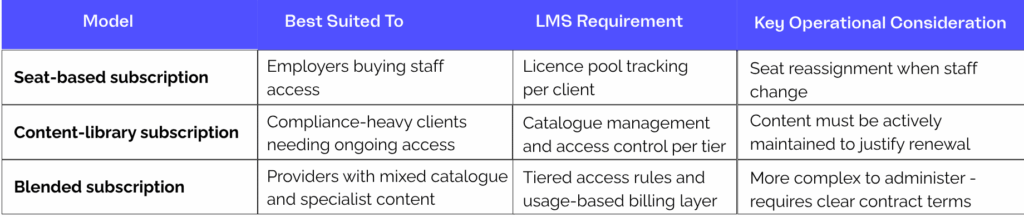
There are three common structures, and the right one depends on your content, your clients, and how you want to price the relationship.

Seat-based subscriptions
A client organisation purchases a defined number of active learner seats per billing period. Seats can be reassigned as employees join or leave. The training provider invoices for the seat count regardless of whether every seat is actively used, which creates an incentive for the client to maximise utilisation and creates a natural conversation about expanding the seat count as the organisation grows.
This model works well when clients have a stable but evolving workforce and want flexibility in who they train without renegotiating the contract each time someone leaves. It is the most common starting structure for B2B training subscriptions and the easiest to explain in a sales conversation.

Content-library subscriptions
A client pays for ongoing access to a defined catalogue of courses for an unlimited or capped number of users. This model suits clients with a compliance-heavy training requirement (health and safety, data protection, regulatory updates, mandatory refreshers) where the need for access is continuous, and the content needs to be kept current. The provider’s obligation is to maintain the catalogue; the client’s obligation is to ensure their people use it.
The pricing logic here is different from seat-based billing. The client is not paying per person; they are paying for access to content that would otherwise need to be sourced individually or produced in-house. For providers with a strong compliance catalogue, this model creates durable relationships with clients whose regulatory environment does not change.

Blended subscriptions
A recurring base fee covers catalogue access or a seat pool, with additional charges for specialist or bespoke content consumed above a threshold. This is the most commercially flexible structure and the most complex to administer. It works well for providers whose offer spans commodity compliance content and high-value specialist programmes where the base subscription covers the former, and the specialist work is priced separately within the same commercial relationship.
The practical requirement here is that your billing infrastructure can handle both the recurring base charge and the variable usage element without manual reconciliation at month-end. That is a platform capability requirement as much as a commercial design question.
The commercial case for moving to subscriptions
The argument for a subscription model is structural, not fashionable. It changes three things about how a training business operates commercially, and each of those changes compounds over time.

Predictability
Monthly recurring revenue gives a training business something a transactional model never provides: a number you can plan against at the start of the month rather than the end of it. When you know that a defined baseline of revenue is going to arrive regardless of whether the sales team closes anything new this month, you can make different decisions about headcount, content investment, and marketing spend.
The compounding effect matters here. A transactional business that doubles its sales effort might double its revenue this month. A subscription business that adds ten new clients to its recurring base adds to a number that will still be there next month, and the month after. The baseline grows as the client base grows, and that growth does not require the same effort to maintain as it did to acquire.

Retention
A subscription relationship changes the nature of the commercial interaction with a client. A transactional client evaluates each purchase independently as the decision to buy again is made fresh each time, against whatever alternatives are currently visible in the market. A subscription client is in an ongoing relationship that renews or cancels on a schedule. The effort required to cancel is higher than the effort required to let the subscription continue, which is one structural reason why subscription churn is typically lower than repeat transactional purchase rates.
The more important reason is that a subscription relationship creates regular touchpoints that a transactional one does not. Utilisation reports, seat reviews, content updates, compliance refreshers – all of these create reasons for the provider and the client to interact between purchases, which builds the kind of relationship that makes renewal a formality rather than a negotiation.

Upsell
A client inside a subscription relationship is the easiest person to sell more training to. They have already committed to an ongoing relationship, they already trust the quality of delivery, and any additional content or seat expansion sits within an existing commercial framework rather than requiring a new sales cycle. The conversation moves from ‘will you buy from us?’ to ‘should we increase your seat count for Q3?’, which is a materially different conversation to have.
For providers with a blended content offer – catalogue compliance training alongside specialist leadership, technical, or sector-specific programmes – the subscription base is the most efficient pipeline for specialist sales, because the client relationship is already warm.
What your LMS needs to support subscription billing in practice
This is the section most content about training subscriptions omits. The commercial model is straightforward to describe. The operational requirements for running it through an LMS are more specific, and getting them wrong is what turns a subscription model from a commercial asset into a manual billing burden.
The following are not optional features for a subscription-based training business. They are the operational requirements that determine whether the model works at scale or collapses into manual administration as the client base grows.
Automated recurring billing
A subscription model that requires your finance team to issue a manual invoice at each renewal date, chase payment, and reconcile receipts against a client list is not a subscription model. It is a transactional model with a calendar. Recurring billing must be automated so that the charges run on schedule, the client receives confirmation, and failed payments trigger a defined workflow rather than a support ticket.
This sounds obvious. It is also the most common failure point for training businesses that try to implement a subscription model without the right LMS platform infrastructure. The billing layer must be native to or tightly integrated with the LMS, so that a billing event and an access decision are connected rather than managed separately.
Licence pool management per client
A seat-based subscription means tracking, per client organisation, how many seats are allocated, how many are currently active, and whether the client is approaching their capacity. This needs to be visible to the training provider’s admin team without generating a manual report, and ideally visible to the client’s own administrator without requiring the training provider to act as an intermediary.
With ten clients, managing this manually is uncomfortable but possible. At twenty clients, each with their own seat count, billing date, and usage pattern, the manual overhead becomes unsustainable. The LMS must hold this information natively and surface it through reporting rather than requiring it to be maintained in a parallel spreadsheet.
Client administrator access
Subscription clients who can self-manage their own learner pools – adding new starters, deactivating leavers, reassigning seats, and pulling their own usage reports – require less support from the training provider and have a materially better experience of the subscription relationship. Every request that the client has to route through the training provider’s central admin or support team is friction that accumulates over the life of the relationship.
This is a platform permission question, not an account management question. The LMS must support scoped client administrator access, an account that gives the client organisation control over their own users and data without giving them visibility into other clients’ environments.
Consolidated revenue and learning reporting
A subscription model generates two categories of data that need to sit alongside each other to manage client relationships proactively: commercial data (renewal dates, seat utilisation rates, billing history, outstanding payments) and learning data (completions, compliance status, time on platform, course uptake by cohort).
When those two data sets live in separate systems (an LMS for the learning side and a spreadsheet, CRM, or separate billing platform for the commercial side), producing a complete picture of a client relationship requires pulling from multiple sources and joining the data manually. For a provider managing twenty subscription clients, each with their own reporting cycle, that happens twenty times a month. The LMS must consolidate both data sets within a single reporting environment.
Accipio One Shop: subscription billing built natively into Moodle and Totara
Accipio One Shop is Accipio’s native eCommerce layer for Moodle and Totara, designed for commercial training providers rather than individual course creators. Subscription billing, seat-based licence management, client administrator access, and consolidated commercial and learning reporting are built into the product rather than available as extensions or integrations.
Because it is native to the LMS and shares the same database, user accounts, and reporting infrastructure as the learning platform, the operational problems described above do not exist in the same form. A billing event and an enrolment decision are the same database operation. Multi-tenancy allows client administrator access as a permission configuration, not a custom development project. Commercial and learning data sit in the same reporting environment by default.
The specific subscription capability covers recurring billing on monthly or annual cycles, configurable seat pools per client organisation, client-level utilisation reporting, and automated billing workflows, including renewal notifications and failed payment handling, are all managed from within the same interface as the learning platform itself.
And because it is native to Moodle and Totara, there is no bridge to maintain, no WordPress dependency, and no synchronisation failure mode. Platform updates are managed as part of Accipio’s managed hosting service, not as a separate compatibility exercise across two independent codebases.
Accipio holds Moodle Premium Certified Partner status and Totara Platinum Partner status. Accipio One Shop is one component of the Accipio One plugin suite, which also covers apprenticeship management, assessment governance, and skills diagnostics.
If you are evaluating eCommerce options for a Moodle or Totara platform and your sales model involves client organisations, licence management, or B2B invoicing, the Accipio One Shop page covers the details.

Three objections worth addressing honestly
Subscription models are not right for every training business at every stage, and naming the objections directly is more useful than pretending they do not exist.
Our clients prefer to buy course by course
Some do, for some content. The two models are not mutually exclusive. A training provider can offer subscription access for a core compliance catalogue while continuing to sell specialist or bespoke programmes transactionally. The subscription relationship becomes the anchor that makes transactional sales easier – the client already has a billing relationship, and adding a specialist programme sits within that context rather than requiring a new procurement conversation.
We do not have enough content to justify a subscription
The content volume threshold is lower than most providers assume, particularly in a B2B context where the content is sector-specific and directly relevant to the client’s regulatory or skills requirements. A focused, high-quality catalogue of thirty courses in a defined sector is more defensible as a subscription proposition than a broad, shallow library of two hundred generic courses. The question is not how much content you have; it is whether the content you have is genuinely useful to the clients you are targeting on an ongoing basis.
We are not sure our clients would commit to annual billing
Monthly billing reduces the commitment barrier significantly. Most B2B subscription relationships that start on monthly billing migrate toward annual terms as the client relationship matures, because the discount for annual commitment is meaningful from the client’s perspective and the reduction in churn risk is meaningful from the provider’s perspective. Starting with monthly billing is a reasonable commercial decision, not a compromise.
Frequently asked questions about corporate training subscription models
What is a corporate training subscription model?
A corporate training subscription model is a commercial structure in which a client organisation pays a recurring fee (generally monthly or annually) for ongoing access to training content or a defined number of learner seats. Unlike transactional course purchases, the subscription renews on a defined schedule, and the revenue recurs without requiring a new sales event. In a B2B context, the subscription is typically held by the client organisation rather than by individual learners, with the client managing access across their own team.
This sounds obvious. It is also the most common failure point for training businesses that try to implement a subscription model without the right LMS platform infrastructure. The billing layer must be native to or tightly integrated with the LMS, so that a billing event and an access decision are connected rather than managed separately.
How do I set up subscription billing for online training?
Subscription billing for online training requires a platform that can automate recurring charges against client accounts, manage licence pools per client organisation, and connect billing events directly to learner access decisions. Renewals trigger continued access, and a cancellation or failed payment triggers an access change, without manual intervention. The billing layer should be native to or tightly integrated with the LMS to avoid the reconciliation overhead of managing subscription data and learning data in separate systems.
With ten clients, managing this manually is uncomfortable but possible. At twenty clients, each with their own seat count, billing date, and usage pattern, the manual overhead becomes unsustainable. The LMS must hold this information natively and surface it through reporting rather than requiring it to be maintained in a parallel spreadsheet.
Can I offer both subscription and one-off course sales from the same LMS?
Yes. Most commercial training businesses run both models simultaneously: a subscription for ongoing catalogue access and transactional pricing for specialist or bespoke programmes. The LMS needs to support both billing structures within the same platform, so that a client can hold an active subscription and purchase additional content transactionally without requiring a separate invoice process or a separate client record.
This is a platform permission question, not an account management question. The LMS must support scoped client administrator access, an account that gives the client organisation control over their own users and data without giving them visibility into other clients’ environments.
What is the difference between a training subscription and a licence agreement?
A licence agreement grants access rights for a defined period and is typically negotiated and invoiced manually. A subscription model automates that cycle in which the billing recurs, the access renews, and the commercial relationship continues without requiring a new agreement at each renewal point. In practice, many B2B training relationships operate on licence terms that function like subscriptions but are administered manually; the operational difference is whether the billing and access management happen automatically or require intervention at each renewal.
When those two data sets live in separate systems (an LMS for the learning side and a spreadsheet, CRM, or separate billing platform for the commercial side), producing a complete picture of a client relationship requires pulling from multiple sources and joining the data manually. For a provider managing twenty subscription clients, each with their own reporting cycle, that happens twenty times a month. The LMS must consolidate both data sets within a single reporting environment.
How should I price a corporate training subscription?
Pricing a B2B training subscription depends on three variables: the value of the content to the client’s specific context (sector-specific compliance content commands a premium over generic material), the seat volume (per-seat pricing typically decreases at higher volumes to reflect the reduced marginal cost of adding users), and the billing frequency (annual billing is typically discounted against monthly to reflect the cash flow benefit and reduced churn risk for the provider). Starting with a seat-based model at a price point that reflects the cost of the client sourcing equivalent training individually is a reasonable anchor for initial conversations, with volume tiers introduced as the client base grows.