

17 Apr What Is an Apprenticeship Management System – and Do You Need One?
If you are evaluating apprenticeship management software, the architecture you choose will determine how your programme runs day to day, what Ofsted sees when they inspect, and what it costs to administer at scale
The term Apprenticeship Management System (AMS) means different things depending on who is using it, and what kind of apprenticeship they are using it for. Some vendors use it to describe a compliance and tracking tool that sits alongside an LMS. Others use it to describe a platform that attempts to handle both learning delivery and programme administration in a single product. Some LMS providers use it loosely to suggest that their LMS platform can be easily configured to manage the end-to-end apprenticeship process. That ambiguity creates genuine difficulty for FE colleges and employers who offer apprenticeship training to evaluate what they actually need.
This post answers three questions directly. What an apprenticeship management system actually is and what it does. Why a standalone AMS that tries to also be an LMS will always compromise on learning delivery, and why an LMS without proper AMS functionality creates compliance and programme management risk. And finally—why the architecture that resolves both without compromise is a purpose-built AMS layer integrated natively within a proper LMS.
The honest answer to “do you need one?” depends on your programme scale, your ESFA registration status, and your Ofsted obligations. This post will give you a clear framework for working out which side of that line you sit on.
What an apprenticeship management system actually does
An AMS is a platform layer that manages the administrative, compliance, and reporting obligations specific to apprenticeship programme delivery. It goes beyond learning delivery, which an LMS handles, to cover the programme management obligations that ESFA registration and Ofsted inspection impose on providers and employers.
The core functions that define the category are: learner tracking across the full programme lifecycle from onboarding to EPA gateway; off-the-job training (OTJT) recording and reporting to ESFA-required standards; progress review scheduling, documentation, and evidencing for the required twelve-weekly three-way reviews between learner, employer, and provider; employer engagement and communication workflows; ILR data preparation and submission; RAG status dashboards that give programme managers early visibility of learners at risk of falling behind or withdrawing; and skills scan functionality to establish baseline knowledge at programme start.
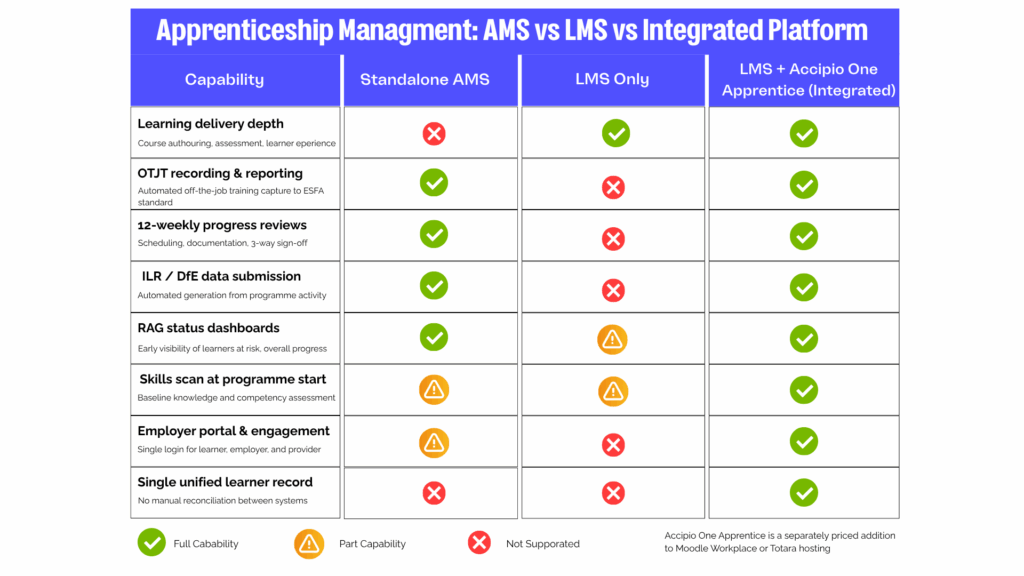
The distinction that matters is this: an LMS delivers and tracks learning content. An AMS also manages the programme, the compliance obligations, and the stakeholder relationships that surround that learning. Both are necessary for a well-run apprenticeship programme. The question is whether they should be separate systems or a single integrated platform, and Accipio believes that question has a clear answer.
The problem with a standalone AMS that tries to be an LMS
Many platforms in the apprenticeship market were built primarily as compliance and tracking tools and subsequently expanded to include learning delivery functionality. The intention is understandable – offering a single platform is commercially attractive. The reality is that a system built with compliance management as its architectural priority will always compromise on the depth and quality of its learning delivery.
The limitations tend to surface in specific areas. Course authoring capability is typically thin. Adequate for basic content delivery but insufficient for complex, branching learning pathways or sophisticated assessment design. Assessment functionality rarely matches what a proper LMS provides: competency-based progression, configurable grading structures, question banks with randomisation, and the kind of detailed reporting that a quality assurance process requires. Learner experience design, especially elements such as personalised dashboards, adaptive learning paths, and social and collaborative learning tools are rarely a priority in a system whose primary design goal was ESFA compliance.
For FE colleges running apprenticeship programmes alongside full qualifications, this creates a particular problem. The learning design standards expected in a further education context, especially those scrutinised by Ofsted under the Education Inspection Framework, require a platform with genuine pedagogical depth. A compliance tool with a course player bolted on does not meet that standard.
For large employers running in-house apprenticeship programmes, the issue is different but equally significant. The learning content that supports an apprenticeship standard needs to connect meaningfully with the employee’s wider development, including their role-specific training, their performance objectives, and their skills development pathway. A standalone AMS cannot integrate with those elements because it was not built to be a learning environment. It was built to be a compliance tracker.
The problem with an LMS that tries to manage apprenticeship programmes
The mirror problem is equally common and equally costly. Many FE colleges and employers run their apprenticeship programmes on an LMS (often one they already use for other training delivery) and manage the programme administration around it through spreadsheets, shared drives, and manual processes. The LMS does what it was designed to do: deliver and track learning. Everything else is handled outside it.

OTJT recording
Off-the-job training hours are an ESFA requirement and a consistent Ofsted inspection focus. Without a system that captures and reports on OTJT automatically from programme activity, providers and employers rely on manual logs, learner self-reporting, or spreadsheet compilation, all of which introduce inconsistency, error, and audit risk. When an Ofsted inspector asks to see OTJT evidence for a cohort of fifty learners at short notice, the quality of that evidence depends entirely on the rigour of the manual process.
Progress review management
Twelve-weekly progress reviews between learner, employer, and provider are a programme requirement. Scheduling, conducting, documenting, and evidencing these reviews across a cohort of thirty, fifty, or a hundred learners manually is an administrative burden that grows with every learner added. Without a system that manages the scheduling, generates the documentation templates, records the outcomes, and flags missed reviews automatically, programme managers spend a disproportionate amount of time on administration rather than on learner support.

ILR and ESFA submission
The Individualised Learner Record is a funding and regulatory requirement for ESFA-registered providers. Errors or delays in ILR submission create funding risk. Without a system that generates ILR-compliant data automatically from programme activity, such as learner starts, planned end dates, achievement records, and withdrawal reasons, the data preparation process is manual, time-consuming, and dependent on the accuracy of information spread across multiple sources. That dependency on human accuracy at the point of regulatory submission is an unnecessary and manageable risk.
The operational cost of running a two-system model – a proper LMS alongside manual programme administration – is explored in full in our post on why running your apprenticeship programme across two systems costs more than you think. The short version is that learner data exists in two places, never fully synchronised; tutors switch contexts during every learner interaction; employer reporting requires manual compilation; and come Ofsted inspection, evidence quality depends on how rigorously the manual processes were followed.
The integrated solution: a proper LMS with a native AMS layer
The architecture that resolves both problems is neither a standalone AMS nor a bare LMS. It is a platform with genuine learning delivery depth – the course authoring, assessment functionality, learner experience design, and pedagogical flexibility of a proper LMS – with a purpose-built apprenticeship management layer integrated natively within it. Not connected to it. Not running alongside it. Integrated within it, sharing the same learner record, the same data set, and the same administrative environment.
Moodle Workplace and Totara provide the LMS foundation. Both are enterprise-grade platforms with the learning delivery depth that FE colleges and large employers require. Accipio One Apprentice adds the full apprenticeship management layer natively within either platform: OTJT recording and reporting, progress review scheduling and documentation, skills scans at programme start, RAG dashboards giving programme managers real-time visibility of learner status, EPA gateway tracking, and ILR-compliant data generation from programme activity.
Because Accipio One Apprentice is native to the LMS rather than a separate system, the learner record is unified. A tutor reviewing a learner’s progress in the AMS sees the same data as the learning delivery system is recording. An employer logging into their portal sees both the learner’s course progress and their programme review history in a single view. An Ofsted inspector asking for OTJT evidence receives it from a system that generated it automatically from programme activity, not from a spreadsheet compiled under pressure
Do you actually need an AMS?
Not every organisation delivering apprenticeships needs a dedicated AMS layer, and saying so builds more trust than assuming the sale. There are scenarios where manual programme management is genuinely viable: very small cohort sizes of fewer than fifteen to twenty learners, a single apprenticeship standard with a stable cohort, or an employer-provider running a limited programme where administrative overhead is manageable and Ofsted scrutiny is not imminent.
The calculus changes when cohort size grows beyond roughly twenty to thirty learners, where the manual administrative burden starts to create error and oversight risk. It changes when ESFA registration creates ILR submission obligations that require accurate, timely data. It changes when an Ofsted inspection is approaching and the evidence base for programme quality needs to be demonstrable systematically rather than assembled retrospectively. And it changes when the apprenticeship programme spans multiple standards, multiple sites, or multiple employer partners — at which point the complexity of manual management creates risks that are disproportionate to the effort required to resolve them with the right infrastructure.
For most FE colleges delivering ESFA-registered provision and for large employers running programmes of any meaningful scale, the honest answer is yes, and not because an AMS is a regulatory requirement, but because the alternative is an operational model whose fragility grows with every learner added. The question that then remains is not whether to have AMS functionality, but whether it should sit in a standalone system or within a properly integrated platform.
The architecture question is the only question that matters

The choice facing most apprenticeship providers and large employers is not between an LMS and an AMS. It is between three architectures: a standalone AMS with thin learning delivery, a proper LMS with manual programme administration around it, or a proper LMS with a native AMS layer integrated within it. The first two involve a deliberate compromise on either learning quality or programme governance. The third does not.
Moodle Workplace or Totara with Accipio One Apprentice integrated natively is the architecture that delivers both – the pedagogical depth of a proper LMS and the compliance, reporting, and programme management capability of a purpose-built AMS, all within a single platform, sharing a single learner record, and presenting a single interface to learners, tutors, and employers.
Book a discovery call to talk through your programme scale, your ESFA and Ofsted obligations, and your existing infrastructure. We will give you a direct assessment of which architecture fits your situation and what a well-built integrated apprenticeship platform looks like in practice.