

06 Jul Managed Moodle hosting versus self-hosting: an honest comparison for learning and development teams
An organisation came to us recently under real time pressure. Their self-hosted Moodle platform had drifted several years out of date, its security had been exposed for longer than anyone was comfortable with, and a looming deadline meant the problem could no longer be left alone. We were able to stabilise the platform quickly and return it to a secure, defensible position. What stayed with them afterwards was the realisation that self-hosting had quietly been costing them more, and protecting them less, than they had assumed.
Their experience is a useful way into a question many learning and development teams face: should you host your Moodle platform yourself, or hand it to a managed provider? Both routes are legitimate, and self-hosting genuinely suits some organisations. What follows is an honest look at the trade-offs and at why, for most teams running Moodle to support real training, a fully managed service tends to come out ahead.
What is really at stake with Moodle hosting
Hosting can look like a back-office decision, and it is easy to treat it as one. It is worth remembering what depends on it. The best course content in the world is worth nothing if your learners cannot reach it when they need to, or if the platform holding their data is not secure. Availability, security, support and performance are the foundation that the entire learning experience sits on, so the hosting choice deserves more attention than it usually gets.
The honest case for self-hosting
Self-hosting has real merits, and any fair comparison should start there.
The strongest is control. Running Moodle on your own infrastructure gives you complete authority over the environment, from the hardware and software to where and how learner data is stored. For organisations with strict data-residency requirements, or an in-house team that prefers to keep everything within its own network, that control has genuine value. Because Moodle is open source, self-hosting also offers deep customisation, with the freedom to shape the platform to your exact requirements. There are no ongoing service fees to a hosting partner, and there is the flexibility to change servers, settings, or software whenever you choose.
Those advantages come with conditions worth stating plainly. Hosting an LMS is not the same as hosting a website, so the control only pays off if your team has specific experience in running Moodle to a production standard. The absence of service fees overlooks the cost of the people and infrastructure needed to do the job properly. And flexibility depends entirely on your own staff having the time and the priorities to act. Where that in-house expertise and capacity genuinely exist, self-hosting can be the right call. Where they do not, the merits fall away quickly.
Where self-hosting bites in practice
For most teams, the hard part of self-hosting arrives after go-live, in what the platform demands to keep running safely. Four areas cause the most trouble.

Security and compliance
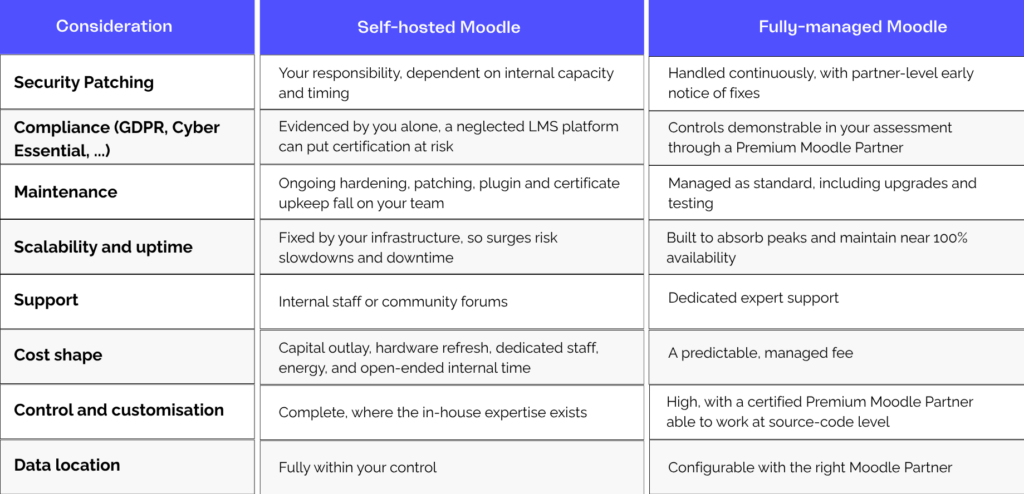
A self-hosted Moodle makes you entirely responsible for your own security. Moodle issues a steady stream of security advisories covering issues such as cross-site scripting, request forgery, and server-side request forgery. Without someone applying those fixes promptly, known vulnerabilities stay open, leaving the platform exposed to data breaches, ransomware, and tampering. An out-of-date version compounds the problem, because once a release passes its security-support cut-off, the fixes simply stop being produced.
Compliance sits on top of this. If your organisation handles personal data, and any LMS holding learner records does, you are responsible for meeting your obligations under GDPR. Increasingly, buyers and frameworks also expect security certifications such as Cyber Essentials or Cyber Essentials Plus, the UK Government-backed scheme overseen by the National Cyber Security Centre. Because that certification covers the whole organisation, an internet-facing Moodle holding learner data falls inside its scope, so a neglected platform can put the wider certification at risk. This is often the moment a self-hosting problem becomes visible, when a contract or an audit forces the question.

Maintenance and the load on your IT team
Keeping a self-hosted Moodle secure and current is a continuous job rather than a one-off setup. A full security hardening of the platform is a substantial exercise in its own right, covering file permissions, TLS and security-header configuration, and a locked-down configuration. The harder part is the discipline that follows: applying security patches within a safe window, troubleshooting plugin conflicts, renewing SSL certificates, and keeping PHP and dependencies current, month after month. Recent Moodle releases have raised the bar further, with changes to the underlying file structure that break many shared hosting setups, so major upgrades now need careful testing rather than a quick update.
That work usually lands on an internal IT team who are not LMS hosting specialists and who already have a long list of other responsibilities. When something breaks at an awkward moment, self-hosting offers no dedicated support line, so the fix depends on your own staff or on community forums. Managed hosting takes that specialist, admin-heavy job off their plate and puts a provider on the hook for it.

Scalability, uptime, and performance
A self-hosted platform is limited by the processing power, memory, and bandwidth you have allocated to it. That matters most at exactly the wrong moment, when a large group of learners logs in at once to complete a mandatory module against a deadline. Fixed infrastructure can struggle with that kind of surge, leading to slow load times, crashes, and a poor experience for learners and administrators alike. Scaling to cope means investing in more infrastructure, which is both complex and costly. A managed environment is built to absorb these peaks and keep the platform available, which protects both the learning experience and the credibility of the programme behind it.

The true cost of self-hosting
Moodle’s open-source licence is free, and that genuine saving is where the cost argument usually stops. The rest of the bill is easy to miss. There is the capital outlay on servers and infrastructure, and the refresh cost when that hardware reaches the end of its life. For anyone running on-premises, there is the space those servers occupy and the energy to power and cool them. Above all, there is the skilled labour. Running a production Moodle LMS to a secure standard consumes somewhere in the region of 180 to 300 hours of skilled technical work a year, and independent estimates put the commitment at between half and a full dedicated full-time equivalent. Set against a predictable managed fee, the free platform often turns out to be the more expensive option.
How a fully managed Moodle service answers each of these
A fully managed and hosted Moodle service is designed to remove these problems, and it maps directly onto the four areas above.
On security, patching is handled continuously and promptly. As a Premium Moodle partner, we are notified of security fixes in the week before each release, ahead of the public disclosure that self-hosting teams typically work from, so we act on the earliest possible warning. The platform arrives hardened as a standard rather than as a project you have to schedule, and major upgrades are managed and tested before they reach your live site.
On compliance, the Cyber Essentials requirements state that where you use an externally managed service, you must be able to demonstrate that the controls are being met. A Premium partner makes that straightforward to evidence in your assessment.
On scalability and uptime, a managed environment is built to handle demand peaks and keep the platform available, so a mandatory-training rush does not become an outage. And on cost, a predictable fee replaces the mix of capital outlay, hardware refreshes, and open-ended internal time that self-hosting accumulates.
You do not have to choose between control and peace of mind
The usual objection to managed hosting is a fear of losing control, and it is a fair one. It is also where an open-source partner changes the picture. Because Accipio works with Moodle at source code level and has been awarded the highest certified Premium Partner tier, our managed service can preserve much of the control and customisation that draws teams to self-hosting, while handing over the risk, the maintenance, and the uptime obligation to us. You keep a platform shaped around your requirements, without carrying the operational burden of running it yourself.
Accipio holds itself to the same standard
We recommend this standard because we adhere to it. Accipio is certified to Cyber Essentials Plus and to ISO 27001, so the managed service we provide is delivered from within an independently audited security posture. The protection we put around your platform is the protection we hold ourselves to.
Managed versus self-hosted Moodle at a glance
How to choose between them
The honest answer is that it depends on your organisation. Self-hosting can be the right choice if you have genuine in-house Moodle hosting expertise, spare capacity on that team, and specific data-residency needs, and if you are willing to own the security and uptime that come with it. A fully managed service tends to be the better choice if you want predictable availability, the maintenance and patching handled for you, demonstrable compliance, and your internal team freed to focus on learning rather than infrastructure. For most teams running Moodle to support real training outcomes, the managed route removes more risk than it introduces.
Talk to an Accipio expert
If any of this sounds close to your own setup, the useful next step is a short conversation. Book a call with an Accipio expert, and we will review your current Moodle hosting, the risks and costs it carries, and what a fully managed alternative would look like for your organisation.
Frequently asked questions
Is self-hosted Moodle secure?
It can be, but only with continuous effort. Security depends on applying Moodle’s regular security fixes promptly, keeping the version supported, and hardening the server. Once a self-hosted platform falls behind on updates, known vulnerabilities remain open and the risk rises quickly.
Does a Moodle LMS need Cyber Essentials?
Cyber Essentials certifies your whole organisation rather than a single product, and an internet-facing Moodle holding learner data falls within its scope. If your organisation needs the certification, often to meet a contract or framework, your LMS has to meet the standard along with everything else (NCSC, ncsc.gov.uk).
Is managed Moodle hosting more expensive than self-hosting?
Not usually, once the full picture is counted. Self-hosting adds capital costs, hardware refreshes, and a large amount of skilled internal time to the free licence. A predictable managed fee often works out lower than the true cost of doing the job well in-house.
Can you still customise Moodle on a managed service?
Yes. With a Premium Moodle partner like Accipio working at the source-code level, a managed platform can be tailored specifically to your requirements, so you keep the customisation without carrying the maintenance and security burden.
At Accipio, all of our clients benefit from the multi-award-winning customisation projects that we’ve done for our clients, because many of the changes that we make find their way into our standard Moodle offering. And our Accipio One suite of plugins offers unparalleled levels of customisation.
What happens if my self-hosted Moodle falls behind on updates?
It ends up running on a version that no longer receives security fixes, which leaves known vulnerabilities open, can breach your compliance obligations, and tends to surface at the worst time, during an audit or a security review.