

25 Mar What Is Moodle Workplace, and Why Does It Matter for New Zealand Organisations?

Most people who have heard of Moodle know it as the world’s most widely deployed open-source learning management system. What fewer people know is that there is an enterprise edition, Moodle Workplace, that adds a layer of capability specifically designed for organisations managing workforce development at scale.
Until recently, that capability was not readily accessible to New Zealand organisations from a qualified local partner. That has now changed. But before we explain what has changed, it is worth being clear about what Moodle Workplace actually is, what it does differently from standard Moodle, and how to assess whether your organisation needs it.
Moodle and Moodle Workplace: What Is the Difference?
Standard Moodle is a powerful, flexible, open-source LMS. It is used by universities, schools, government agencies, and businesses across the world, and for many organisations it is exactly the right tool. It handles course delivery, assessment, completion tracking, and a wide range of integrations competently and at a fraction of the cost of proprietary alternatives.
Moodle Workplace builds on that foundation. It is the same proven core, extended with a set of capabilities that address the specific complexity of enterprise and multi-entity learning operations. The additions are meaningful, and they are aimed squarely at organisations that have outgrown what standard Moodle can manage cleanly.
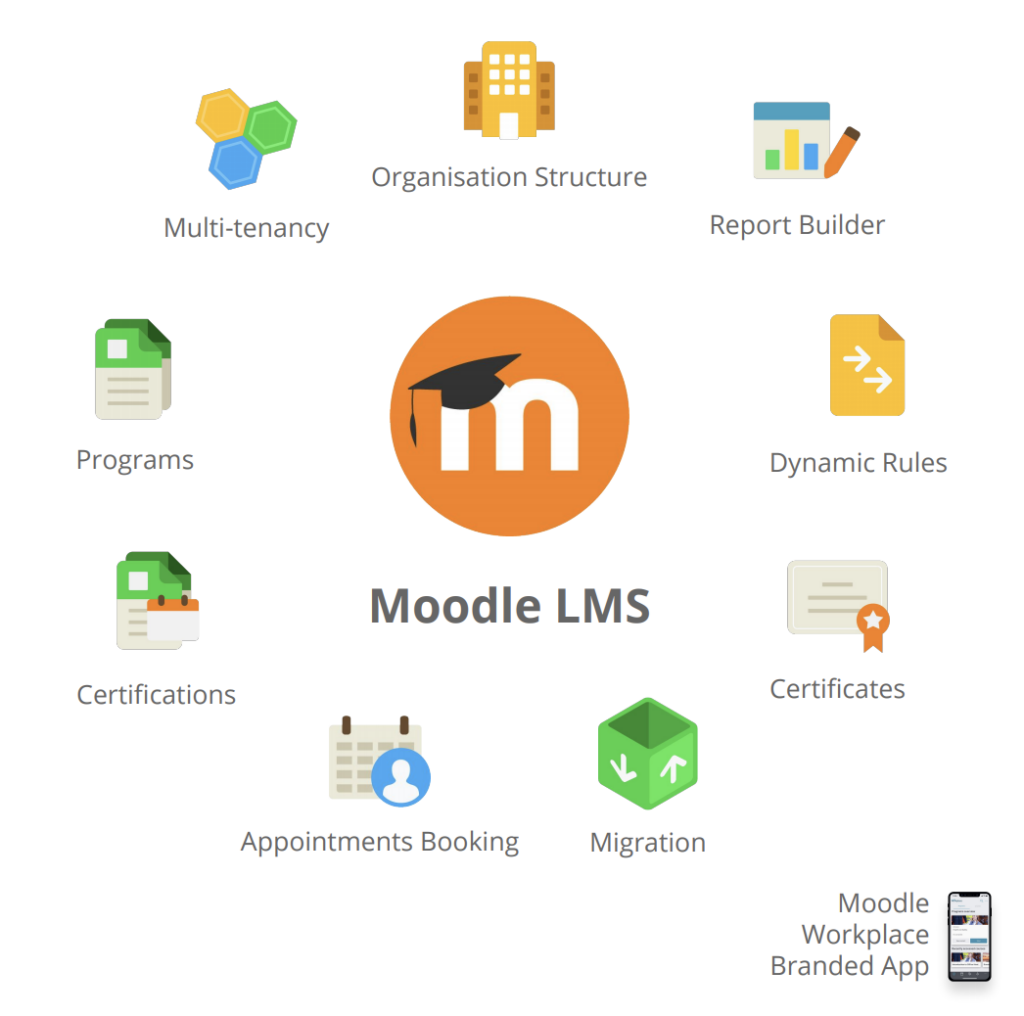
The headline capabilities Workplace adds are as follows.
Multi-Tenancy
For organisations with multiple business units, subsidiaries, franchise networks, or client groups, multi-tenancy is the capability that makes a single Moodle instance work for all of them simultaneously, without each group seeing what they should not, and without administrators having to maintain separate systems.
Each tenant can have its own branding, its own catalogue of courses, its own learner population, and its own reporting, all managed from a single platform. For a government agency with multiple departments, a training provider with several client organisations, or a corporate with distinct regional teams, this removes the need to either run multiple separate LMS instances or accept a one-size-fits-all approach that serves nobody particularly well.
Automated Learning Programmes
In standard Moodle, enrolment and programme sequencing are largely manual or require custom configuration. Moodle Workplace introduces dynamic rules that automate learning pathways based on an individual’s role, department, location, or other attributes.
When someone joins a team, changes roles, or reaches a particular stage in their career, the right learning is assigned automatically. Onboarding programmes, compliance refreshers, and role-based development paths can be configured once and run without ongoing manual intervention. For organisations managing large or frequently changing workforces, this is the difference between a system that scales and one that creates more administrative work as it grows.
Competency Frameworks
Workplace integrates competency frameworks directly into the learning experience, allowing organisations to map courses and programmes to the skills and capabilities they are developing in their people. Progress against competencies can be tracked, reported on, and tied to performance or development conversations.
For organisations that take workforce capability seriously, such as professional services firms, regulated industries, and public sector bodies with defined competency requirements, this moves the LMS from a course-delivery tool into something closer to a genuine workforce development platform.
Advanced Reporting and Analytics
Moodle Workplace extends the standard Moodle reporting suite with more granular, configurable reporting that can be scoped to individual tenants, departments, or learning programmes. Leaders and managers can access the data they need without requiring administrator-level access to the whole platform, and reports can be scheduled and distributed automatically.
For L&D and HR teams that are expected to demonstrate the impact of learning investment, this matters. Completion rates and time-on-course are a starting point; Workplace allows you to go considerably further.
Who Is Moodle Workplace Actually For?
Moodle Workplace is not an upgrade for everyone. It is the right tool for organisations whose learning operations have a complexity that standard Moodle manages awkwardly, and who are prepared to invest in configuring it properly.
In practical terms, Workplace is worth evaluating seriously if any of the following apply to your organisation:
- You are managing learning across multiple teams, departments, or client groups that need separate administration, reporting, or catalogues.
- You are spending significant time manually assigning courses or managing enrolments that could be automated.
- You are trying to connect learning activity to competency development or performance in a systematic way.
- You are running compliance or regulatory training at scale and need reliable, auditable reporting.
- Or you are a training provider selling or licensing learning to external client organisations.
If none of those applies and you have a single learner population, a straightforward course catalogue, and modest reporting needs, a standard Moodle LMS is likely the more cost-effective and appropriate choice. The right answer depends on your organisation’s actual requirements, not on the appeal of a more sophisticated platform.
Why Has Moodle Workplace Adoption Been Low in New Zealand?
Moodle Workplace is only available through Premium Moodle Certified Partners, the highest tier of Moodle’s partner programme. Until now, New Zealand has had limited access to Premium-tier partners with the depth of experience needed to implement Workplace properly.
The result is that many New Zealand organisations have either not known Workplace exists, or have looked at it and found no credible local path to implementation. Some have defaulted to proprietary enterprise platforms at significantly higher cost. Others have persisted with standard Moodle configured in ways that approximate what Workplace does natively, with predictable limitations.
Accipio’s arrival as a Premium Moodle Certified Partner in New Zealand changes that picture directly.
What Accipio Brings to Moodle Workplace in New Zealand
Achieving Premium Moodle Certified Partner status is not an administrative exercise. It reflects a track record that Accipio has built over more than a decade implementing and supporting Moodle, Moodle Workplace and Totara for some of the UK and Europe’s most demanding organisations, including NHS Trusts, the Metropolitan Police, the College of Policing, the Premier League, PepsiCo, and Eton College. These are not straightforward LMS deployments. They involve scale, complexity, regulatory obligation, and a low tolerance for failure.
That depth of experience matters for New Zealand clients for a specific reason: Moodle Workplace is not a platform you configure once and leave. It requires genuine technical expertise to implement well, and the quality of the implementation determines how much of the platform’s capability an organisation actually uses. Accipio brings that expertise to New Zealand through a local team led by Austen Sinclair, backed by the full technical and professional services capability of the UK operation.
But Premium Moodle Certified Partner status is only part of what Accipio brings to the New Zealand market. The other part is Accipio One, a suite of proprietary plugins built natively on Moodle and Totara that extend these platform’s capabilities well beyond what, for example, Workplace provides out of the box. Bringing this additional level of functionality to Moodle is unique to Accipio.
Accipio’s Accipio One plugin suite extends the platform further, transforming your enterprise learning ecosystem into a high-performance engine by unifying seamless LMS eCommerce capabilities, automated apprenticeship management, AI-driven curation, and an automated grading suite that simplifies complex assessment workflows into one frictionless, expert-led platform – along with a range of additional modules that can be configured to match an organisation’s specific needs.
Accipio One: What It Does and Why It Matters
Accipio One is not a collection of minor add-ons. It is a set of purpose-built tools that address the operational problems that LMS platforms like Moodle Workplace do not solve on their own. Each plugin has been developed and refined through real deployments at scale. Taken together, they transform Moodle Workplace from an enterprise LMS into a complete operational platform for workforce development, commercial learning, and assessment governance.
For organisations selling training commercially – whether that is a training provider, a professional body, a franchise, a membership organisation, or a university running a commercial CPD operation – Accipio Shop is the infrastructure that makes it possible to do this properly. Standard Moodle has no native commerce layer. Organisations typically bolt on Stripe or WooCommerce, which handles individual transactions but nothing else. Shop handles individual purchases, multi-seat corporate buying, subscriptions, bundle pricing, voucher codes, VAT, and time-limited access – all within the LMS, without fragmentation. It also automates the client-side administration that manually-invoiced accounts generate: corporate clients can self-manage their own users, allocate licences, run completion reports, and download certificates without raising a support ticket.
HFL Education generated seven figures in revenue through Shop in ten months, managing 30,000 licences across their client base. Tes and EduCare run more than 500,000 users across 6,000 organisations on the same infrastructure. These are not proofs of concept – they are production deployments at genuine scale.
For universities and polytechnics in New Zealand, the case for Accipio One Grade is particularly direct and it addresses a situation that is more common in New Zealand than it should be. Many tertiary institutions default to Canvas because it is familiar. The honest assessment is that Canvas is a capable course-delivery platform. What it cannot do is automate the assessment governance that tertiary institutions are obligated to maintain: anonymous marking, blind and double-blind moderation, escalation to third markers where first and second markers disagree, and complete audit trails for external examiners.
Academics and administrators currently manage most of this through spreadsheets and email chains, a process that is time-consuming, error-prone, and a governance risk that typically only becomes visible under a review or a student appeal. Grade automates the entire workflow: anonymous submission handling, automated tutor assignment, blind marking with automatic grade resolution, random sampling for moderation, escalation routing, and external examiner audit trails.
The governance burden that currently sits with academics and administrators becomes a platform function.
For institutions that have accepted Canvas’s limitations as the cost of familiarity, Grade changes the calculation significantly.
Beyond commerce and assessment, Accipio One covers apprenticeship and structured programme management with full compliance tracking, off-the-job training monitoring, and ePortfolio capability; AI-driven content curation and personalised learning recommendations through Discover and Curate; competency benchmarking and 360-degree diagnostics through Diagnose; structured work-based project delivery with tutor sign-off and automatic portfolio generation through Projects; and search optimisation for Moodle and Totara course catalogues through Rank.
These are not features that exist in isolation. They are designed to work together, and in combination with Moodle Workplace’s enterprise foundation, they create a learning platform architecture that very few providers anywhere in the world can match.
For New Zealand organisations that have been running Moodle and wondering whether it can work harder, the answer is yes, considerably harder. For those evaluating platforms for the first time, the combination of Moodle Workplace and Accipio One represents a level of capability that proprietary alternatives charge significantly more to approximate, without the architectural flexibility that open-source provides.
Ready to learn more?
If your organisation is evaluating Moodle Workplace, considering a migration from Canvas, Blackboard, or another platform, or simply trying to understand whether your existing LMS deployment is reaching its potential, we would welcome a straightforward conversation about what is possible.

Website: https://www.accipio.com/contact
Email: austen@accipio.com | sales@accipio.com
Phone: +64 (0) 4 885 4956
Address: Level 2, 40 Lady Elizabeth Lane, Wellington Central, 6011 New Zealand